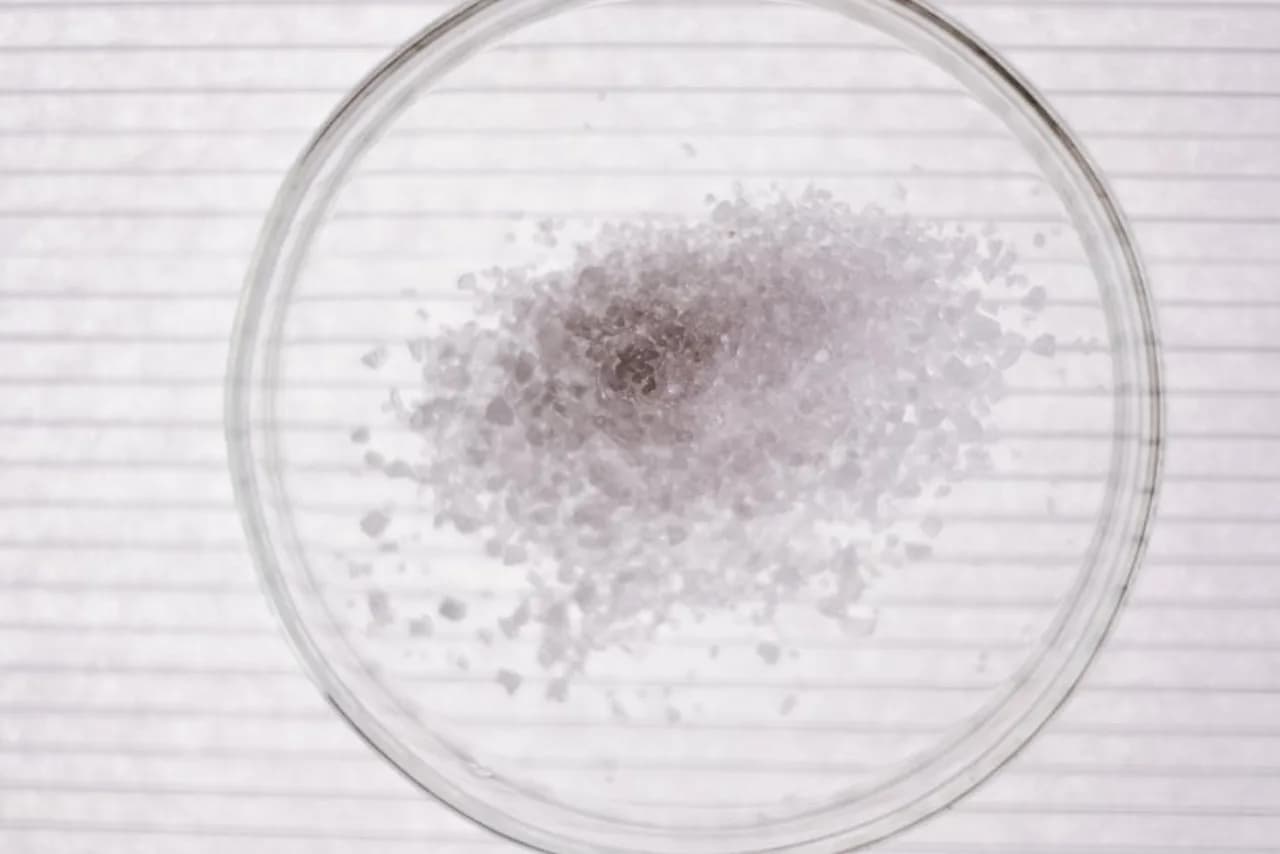
Magnesium chloride flakes and liquid (MgCl2) — the gentlest commercially effective chloride de-icer, lower-corrosion than calcium chloride, popular for environmental sensitivity and concrete-friendly applications.
Magnesium chloride (MgCl₂) is the third major chloride de-icer alongside sodium chloride and calcium chloride. It is significantly less corrosive than calcium chloride on concrete, rebar, vehicle underbodies, and metal building components — typically 30–50 % less aggressive at the same molar concentration.
When should I choose magnesium chloride?
Choose MgCl₂ when:
- Environmental sensitivity is the primary constraint — wetlands, fish-bearing streams, salt-sensitive landscape
- Corrosion of vehicles, rebar, or building components is a recurring issue
- Temperature is –10 to –25 °C — rock salt no longer effective but CaCl₂ unnecessary
- The municipality has standardised on MgCl₂ (Calgary, Whistler, Banff, Whitehorse)
Skip MgCl₂ for routine de-icing above –10 °C (rock salt cheaper, equally effective) and for extreme cold below –25 °C (calcium chloride faster, stays effective to –32 °C).
Is magnesium chloride less harmful to the environment than calcium chloride?
Yes — in measurable ways. The chloride load per equivalent melt performance is comparable across the three chloride de-icers, but:
- Magnesium ion is less mobile in soil than calcium ion
- Less likely to leach into shallow groundwater
- Less aggressive on plant root systems
- Spray drift causes less visible turf damage at the same rate
- Reduces rate of chloride-induced rebar corrosion in concrete
Why does magnesium chloride leave a white residue?
Magnesium chloride flakes contain a hydrated crystal structure (typically MgCl₂ · 6H₂O). As meltwater evaporates, the crystal water releases and the magnesium chloride re-crystallises on the surface as a thin white film.
The residue is cosmetic, not damaging, and washes off with rinsing. Most visible on:
- Storefront glass
- Dark-coloured pavement
- Entrance pads where evaporation is uneven
For high-visibility applications switch to calcium magnesium acetate (CMA) or potassium acetate — both evaporate completely and leave no residue.
Can I mix magnesium chloride with rock salt?
Yes — and it is standard practice in commercial and municipal operations:
- Pre-blend MgCl₂ flakes into rock salt at 5–10 % by weight — delivers most cold-temp performance of straight MgCl₂ at a fraction of the cost
- Liquid MgCl₂ brine pre-wetting — 8–12 gallons per tonne of salt at spreader discharge. Cuts application rate 20–35 %, extends melt to –20 °C
Treated magnesium chloride blends sold as Mag-Plus, ClearLane, IceSlicer. Most commercial contractors blend their own at the salt dome to control ratio and cost.
What does magnesium chloride cost?
| Form | Price |
|---|---|
| Flakes, 25 kg bag at pallet | $550–$800 / tonne |
| Flakes, retail bag | $800–$1,100 / tonne |
| Liquid 30 %, bulk tanker | $250–$420 / tonne eq |
Premium over rock salt: 2–3x. Less than calcium chloride but more than treated salt blends.