Skip to content
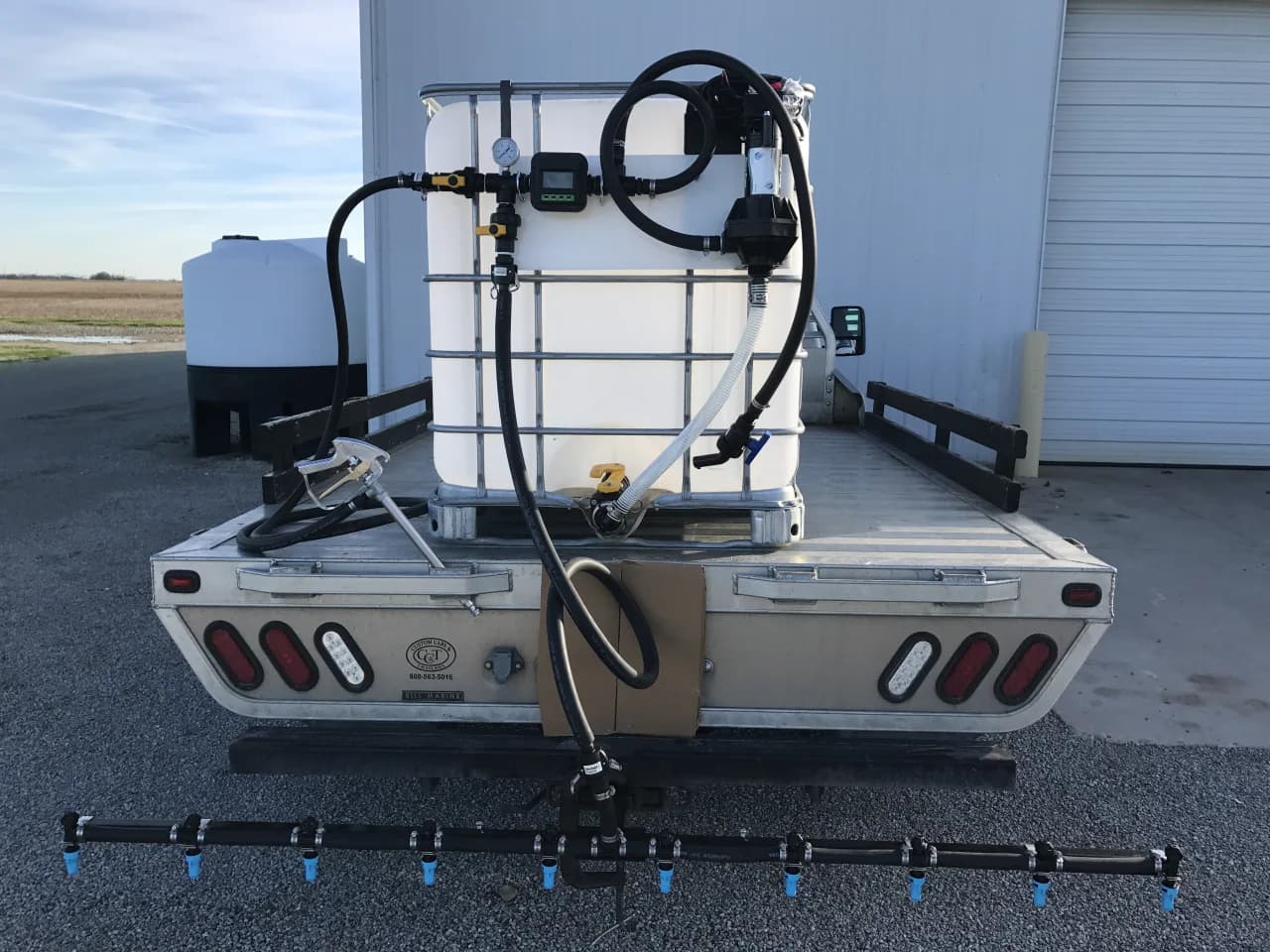
Truck-mounted IBC brine tote with electric pump, flow meter and rear spray boom — salt-brine applicator rig for snow.ca Canadian anti-icing pre-treatment routes ahead of forecast storms.
Home/Supplies/Brine Deicer
Supplies · catalog

Brine Deicer.

Composition
NaCl 23.3 % · CaCl2 32–38 % · MgCl2 28–32 % · organic blends
Effective to
–21 °C to –32 °C depending on brine
Application rate
30–80 gal / lane-mile spray; 8–12 gal / tonne pre-wet
Equipment
Saddle tank sprayer · boom sprayer · pre-wet kit
Packaging
200 L drum · 1,000 L IBC · bulk tanker
Salt reduction
20–40 % vs. dry-only operations
Price range
$120–$480 per tonne equivalent
Brands
GeoMelt · IceBan · ClearLane · Liquid Magic
Key takeaways

Read in 20 seconds.

FAQPage · Schema marked
  1. 01Brine is dissolved chloride salt in water — three commercial concentrations (NaCl 23.3 %, CaCl2 32–38 %, MgCl2 28–32 %).
  2. 02Anti-icing spray ahead of storms cuts post-storm salt application 30–60 %; pre-wetting cuts application 20–35 %.
  3. 03Organic blends (GeoMelt, IceBan) reduce corrosion 30–70 % — standard on bridges and steel decks.
  4. 04200 L drum, 1,000 L IBC, bulk tanker; saddle tank or boom sprayer equipment required.
  5. 05Municipalities running anti-icing programs cut seasonal salt use 25–40 % vs. reactive-only.
Catalog

Pre-wet brine and liquid de-icer — sodium chloride brine, calcium chloride brine, magnesium chloride brine, and organic-blend liquid de-icer — for anti-icing spray, salt pre-wetting, and direct application.

Brine is dissolved chloride salt in water at a working concentration. Used for three jobs in Canadian winter operations: anti-icing spray ahead of forecast storms, pre-wetting dry salt at spreader discharge, and direct liquid application on bridge decks where dry salt scatters.

What are the three commercial brines?

BrineConcentrationEffective toBest for
Sodium chloride brine23.3 % (eutectic)–21 °CRoutine pre-wet, anti-icing
Calcium chloride brine32–38 %–32 °CCold snaps, exothermic activation
Magnesium chloride brine28–32 %–26 °CEnvironmental sensitivity, bridges

What is anti-icing brine and how does it work?

Anti-icing brine is sprayed on pavement 24–6 hours before forecast precipitation. The brine soaks into pavement micro-texture and leaves a chloride residue.

When snow begins to fall:

  1. Residue prevents the first snow contact from freezing into a bond
  2. Snow stays loose on top of the brine layer instead of locking as compacted ice
  3. Mechanical clearing removes snow cleanly down to bare pavement
  4. No scraping, no chemical post-treatment needed

What is pre-wetting salt and why does it work?

Pre-wetting applies liquid brine to dry rock salt at the moment of discharge from a spreader — typically 8–12 gallons of brine per tonne of salt.

The liquid coats each salt crystal, starting the exothermic melt reaction the instant the salt hits the pavement.

  • Faster activation — visible melt in 2–4 min vs 15–30 min for dry salt
  • Wider temperature range — effective to –20 °C with NaCl brine pre-wet (vs –10 °C dry salt alone)
  • Reduced bounce-and-scatter — less salt in landscape and storm drains
  • 20–35 % lower application rate per cleared square foot

Requires a saddle tank on the spreader truck and a controller to time the liquid pulse.

What are organic-blend liquid de-icers?

Organic-blend brines mix calcium chloride or magnesium chloride brine with agricultural co-products:

  • GeoMelt — beet-juice byproduct
  • IceBan — distillation residue + chloride brine
  • Cargill ClearLane — corn-syrup byproduct + chloride brine

These products reduce corrosion 30–70 % below straight chloride brine and are standard on bridges and steel-deck structures where corrosion is the dominant concern.

Trade-offs: 10–25 % higher cost per gallon, slightly reduced melt rate at the lowest temperatures.

What does brine cost in Canada?

BrineBulk tanker1,000 L IBC200 L drum
Sodium chloride 23 %$120–$180/t eq$180–$280/t eq$240–$340/t eq
Magnesium chloride 30 %$250–$420/t eq$320–$520/t eq$440–$640/t eq
Calcium chloride 32 %$300–$480/t eq$380–$580/t eq$480–$680/t eq
Organic blends$320–$520/t eq$400–$640/t eq$520–$780/t eq

What equipment do I need to apply liquid de-icer?

  • Pre-wetting dry salt — saddle tank (100–300 gal) + controller. Total $3,500–$8,500 installed.
  • Direct anti-icing spray — brine sprayer with 8'–40' boom, 200–2,000 gal tank, flow-controlled pump. Total $8,000–$45,000.
  • Low-volume residential / walkway — hand-pump pressure sprayer or backpack sprayer at 1–5 gal/fill.
Standards

What you can expect.

5 STANDARDS
01STANDARD
Photo-verified
Real photos before listing.
02NEW
Dealer-direct
New gear, factory warranty.
03TESTED
Operator-grade
Spec-checked for Canadian winters.
04LOCAL
Local pickup
Depots in 80+ cities.
05FLEXIBLE
Rental or buy
Day, week, season, or own.
Common questions

Asked & answered.

Otherwise, call 888-471-SNOW.

What is anti-icing brine and how does it work?

Anti-icing brine is a chloride salt solution sprayed on pavement ahead of a forecast storm — typically 24–6 hours before precipitation starts. The brine soaks into the pavement micro-texture and leaves a chloride residue. When snow begins to fall, the residue prevents the first contact with the pavement from freezing into a bond — the snow stays loose on top of the brine layer instead of locking to the pavement as compacted ice. Mechanical clearing (plowing) then removes the snow cleanly down to bare pavement, with no scraping, no chemical post-treatment, and dramatically reduced salt consumption. Anti-icing is the single most cost-effective tool in the modern de-icing toolkit and is standard practice in Calgary, Hamilton, Mississauga, Halifax, and increasingly across all major Canadian cities.

What is pre-wetting salt and why does it work?

Pre-wetting is the application of liquid brine to dry rock salt at the moment of discharge from a spreader. A typical pre-wet rate is 8–12 gallons of brine per tonne of salt. The liquid coats each salt crystal, starting the exothermic melt reaction the instant the salt hits the pavement — instead of waiting for the salt to absorb pavement moisture. The advantages are faster activation (visible melt in 2–4 minutes vs. 15–30 minutes for dry salt), wider effective temperature range (–20 °C with NaCl brine pre-wet vs. –10 °C for dry salt alone), reduced bounce-and-scatter (less salt in landscape and storm drains), and 20–35 % lower application rate per cleared square foot. Pre-wetting requires a saddle tank on the spreader truck and a controller to time the liquid pulse to the salt discharge.

What is the eutectic concentration of salt brine?

The eutectic concentration is the concentration of salt in water at which the solution has the lowest freezing point. For sodium chloride the eutectic is 23.3 % NaCl by weight, with a freezing point of –21.1 °C — below that concentration the brine freezes higher (less effective), above that concentration salt crystallises out of solution (wasted product). For calcium chloride the eutectic is 30 % CaCl2 at –50 °C, but practical commercial brines stay at 32–38 % because the higher viscosity at the eutectic causes spray nozzle plugging. For magnesium chloride the eutectic is 21 % MgCl2 at –33 °C; commercial brines run 28–32 %. We mix and verify brine concentration at each depot — every shipment ships with the lot concentration and freezing-point test result.

Where can I buy salt brine in Canada?

For 200 L drum and 1,000 L IBC quantities, industrial chemical distributors — Univar Solutions, Brenntag, ChemTrade — supply all three commercial chloride brines (sodium, calcium, magnesium) and organic blends (GeoMelt, IceBan, ClearLane). For bulk tanker quantities (4,000–20,000 L per delivery), the same distributors deliver direct to municipal and commercial salt domes. We hold supply contracts with the major sources and deliver to depots in every province with 48–96 hour lead time. Many large commercial contractors mix their own sodium chloride brine on-site at the salt dome — a salt-brine maker (typically $25,000–$80,000 for the equipment) dissolves dry rock salt into water at the eutectic concentration and stores the brine in a 20,000–60,000 L tank for use.

What equipment do I need to apply liquid de-icer?

For pre-wetting dry salt, a saddle tank (typically 100–300 gallons) mounted on the spreader truck plus a controller that times the liquid pulse to the salt discharge — total cost roughly $3,500–$8,500 installed. For direct anti-icing spray on pavement, a brine sprayer with boom (typically 8–12 ft wide for parking lot work, 24–40 ft wide for road operations) with a tank between 200 and 2,000 gallons and a flow-controlled pump — total cost roughly $8,000–$45,000 depending on size and on-board controls. For low-volume residential and walkway anti-icing, hand-pump pressure sprayers and backpack sprayers work at 1–5 gallons per fill. All sprayer types require winter-rated materials (polyethylene tanks, stainless or brass fittings, freeze-protected pumps) because brine left in equipment overnight will freeze and rupture standard PVC plumbing.

Continue exploring

Related routes.

ON
Brine Deicer — Toronto
/toronto/brine-deicer
ON
Brine Deicer — Ottawa
/ottawa/brine-deicer
ON
Brine Deicer — Mississauga
/mississauga/brine-deicer
ON
Brine Deicer — Brampton
/brampton/brine-deicer
ON
Brine Deicer — Markham
/markham/brine-deicer
ON
Brine Deicer — Barrie
/barrie/brine-deicer
Truck-mounted IBC brine tote with electric pump, flow meter and rear spray boom — salt-brine applicator rig for snow.ca Canadian anti-icing pre-treatment routes ahead of forecast storms.

Brine Deicer — priced for Canada.