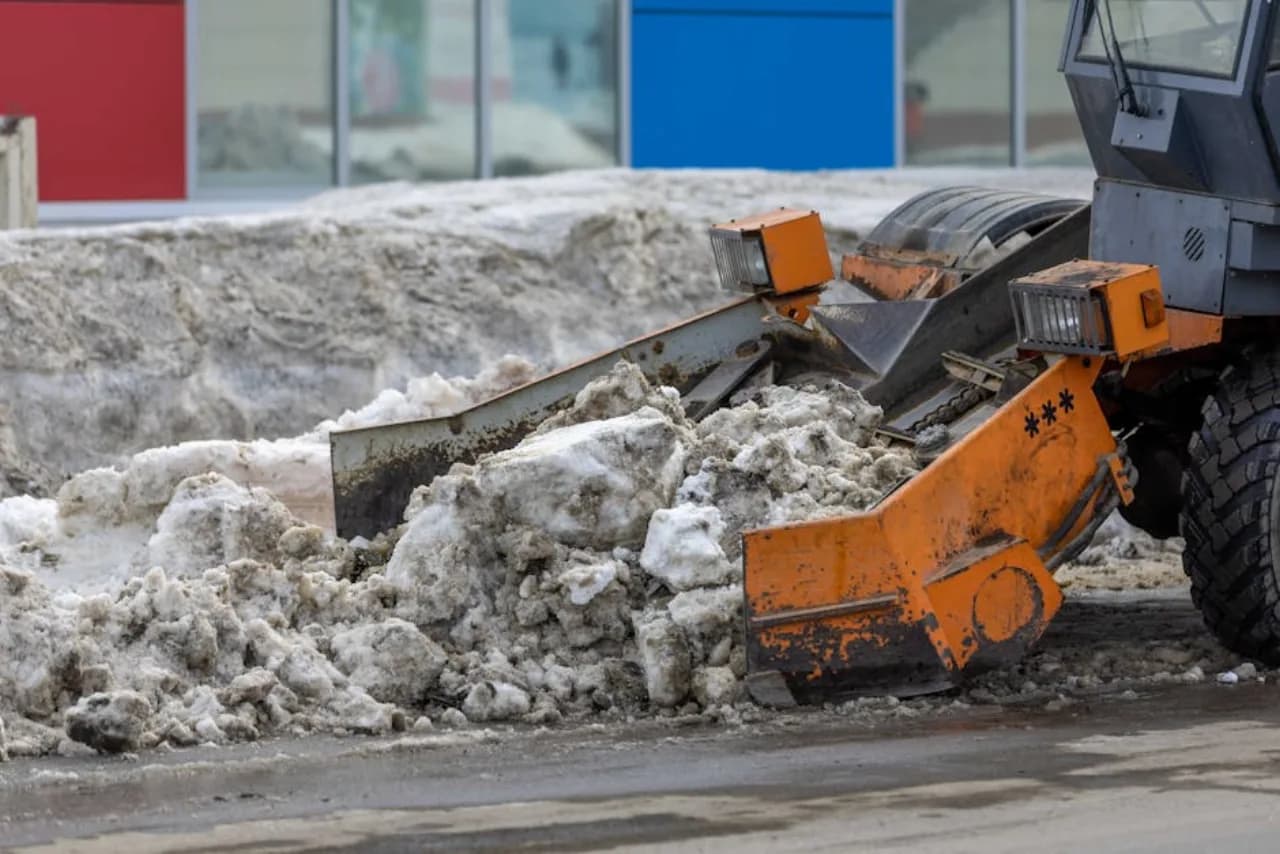
Trailer-mounted snow melters and industrial snow-melting machines for downtown lots, hospital campuses, airports, and condos where snow stacking is not an option — Trecan, Snow Dragon, and SND.
A snow melter is a trailer-mounted or skid-mounted heated tank that melts snow on-site instead of trucking it away. For downtown commercial lots and any property where snow stacking is restricted, a snow melting machine is the only economical answer.
How does a snow melter machine work?
- Snow is loaded into the top of the tank by skid-steer, loader, or conveyor.
- A diesel, natural gas, or propane burner heats water inside the tank to 4–10 °C — warm enough to rapidly melt snow without boiling.
- Loaded snow contacts warm water, melts in seconds.
- Meltwater discharges through a side outlet into storm drain, oil-water separator, or holding tank.
When does a snow melter make economic sense vs. hauling?
Snow melters become economic when on-site hauling cost exceeds $4,500 per storm event — the typical rental threshold for a 20-tonne-per-hour unit. That math kicks in at roughly 18–20 truckloads per storm.
| Property scale | Storms exceeding 18 truckloads | Right tool |
|---|---|---|
| Under 100k sq ft | Rare | Hauling at $250–$500/load |
| 100–250k sq ft downtown | 2–3 per season | Melter rental on heavy storms |
| 250k+ sq ft + zoning restriction | Most major storms | On-site melt every event |
| Hospital / airport / campus | Operational risk | Permanent on-site melter |
What brands of snow melter machine are available in Canada?
- Trecan (Dartmouth, NS) — Canadian-designed, Canadian-built market leader. In service at Pearson, Trudeau, YVR, Halifax Stanfield, and 40+ municipal sites.
- Snow Dragon (Cleveland, OH) — major American-built competitor, common in Maritimes, southwestern Ontario, Lower Mainland.
- SND — mid-range trailer-mounted units popular with contractors.
- Larue Industriel (Saint-Augustin-de-Desmaures, QC) — heavy-duty Québec municipal supplier.
How much does a snow melter cost to rent?
| Capacity | Use case | Weekly rate |
|---|---|---|
| 20 t/hr | City block, mid commercial | $4,500–$6,500 |
| 40 t/hr | Large commercial, retail plaza | $6,500–$9,500 |
| 60 t/hr | Hospital campus | $9,500–$13,500 |
| 100 t/hr | Airport apron | $14,000–$18,000 |
Rates include delivery, on-site fueling, trained operator on standby, and the discharge permit application. Fuel billed separately at cost (25–60 L/hr diesel). End-of-season rates (late March–May) drop 30–45 %.
Where does the meltwater go?
Meltwater is discharged to sanitary or combined sewer through an oil-water separator and grit chamber. Regulations care about hydrocarbons (motor oil, fuel residue) and grit (traction sand) more than chloride content.
- Discharge permit required in Toronto, Montréal, Ottawa, Calgary, Vancouver
- Issued by Public Works or Environmental Services, renewed seasonally
- We provide discharge specs + template municipal application with every rental quote
- Operator carries the discharge permit during operations
Can I melt snow on a residential driveway?
Small-scale snow melters (1–5 t/hr) exist for residential use — propane-fired or electric tank units, $4,000–$25,000. They are sometimes used in downtown townhouse strips in Montréal and Old Toronto where stacking is genuinely impossible.
For 95 % of Canadian residential properties they do not make economic sense — a snow blower, salt application, and occasional truck haul once or twice a season is dramatically cheaper.