Skip to content
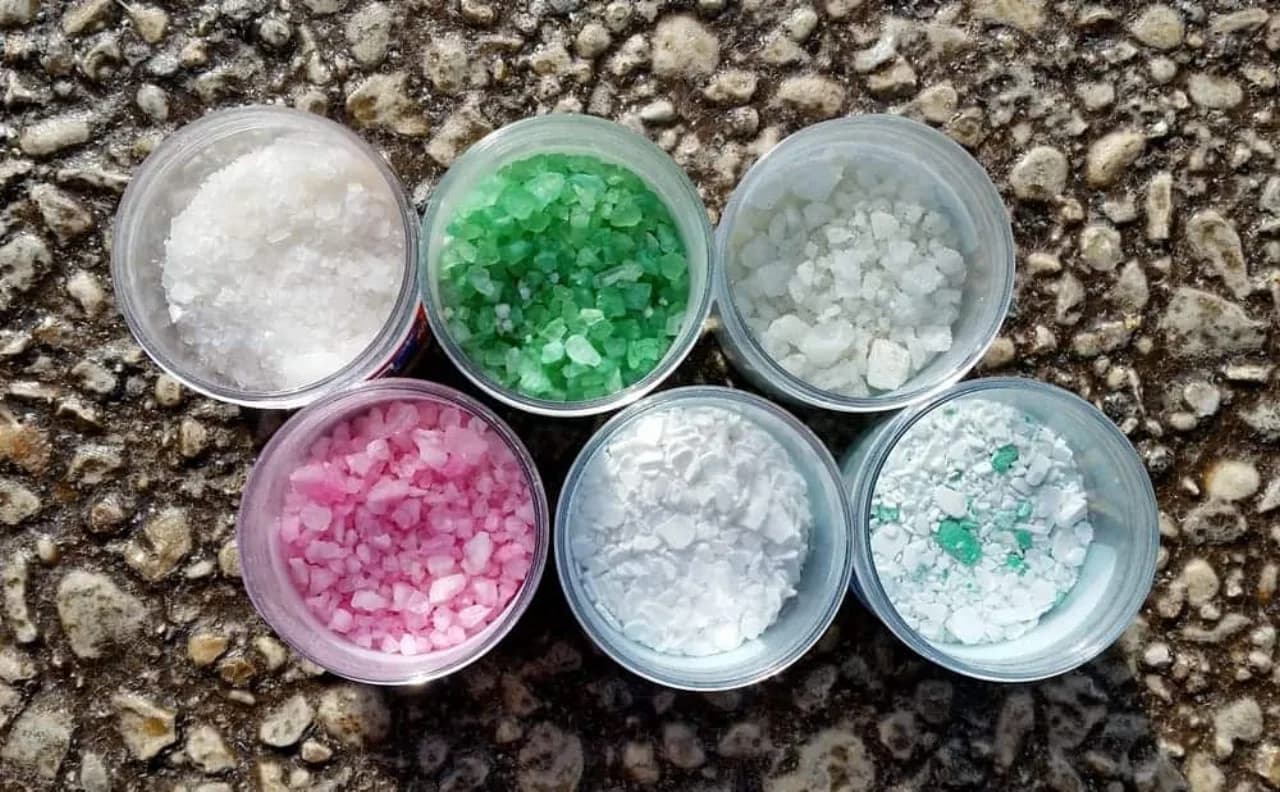
Six bowls comparing de-icer blends — rock salt, treated green and pink chlorides, calcium-chloride flakes and magnesium pellets — the snow.ca product catalog of Canadian commercial de-icers for parking lots and walkways.
Home/Supplies/Deicer
Supplies · catalog

Deicer.

Categories
Chloride · acetate · organic blend · glycol
Forms
Dry granular · dry flake · liquid brine · spray
Temperature range
0 °C to –50 °C depending on product
Application
Spreader (dry) · sprayer (liquid) · hand spreader (residential)
Price range
$180 per tonne (NaCl) – $4,500 per tonne (potassium acetate)
Stocked at depots
Mississauga · Laval · Edmonton · Surrey
Lead time
24–96 hours during season
Documentation
MSDS · lot trace · application chart
Key takeaways

Read in 20 seconds.

FAQPage · Schema marked
  1. 01De-icer is the umbrella for chloride, acetate, organic-blend, and glycol products that melt or prevent ice.
  2. 02Most Canadian commercial operations run 2–4 products: rock salt + treated salt + brine + a cold-temp specialty.
  3. 03Right product depends on pavement temperature, surface material, environmental sensitivity, and budget.
  4. 04Price range $180/tonne (rock salt) to $4,500/tonne (potassium acetate) — right tool for the right job.
  5. 05Full Canadian de-icer catalog with depot stock and MSDS / application chart on every shipment.
Catalog

De-icer category page — the umbrella for all chloride, non-chloride, and organic-blend products used to melt or prevent ice on Canadian roads, parking lots, walkways, and driveways.

De-icer as a noun refers to the *chemistry* — the bag, drum, tote, or tank of product that gets applied. The service that applies it is de-icing (see /services/de-icing). Five product families dominate the Canadian market, each with a different active ingredient, working temperature, and unit price.

Five de-icer families on Canadian shelves

  • Sodium chloride (NaCl) — standard rock salt, $180–$420/tonne, melts to ‒10 °C
  • Calcium chloride (CaCl₂) — pellet or flake, $700–$1,200/tonne, melts to ‒29 °C, exothermic
  • Magnesium chloride (MgCl₂) — pellet or liquid, $580–$880/tonne, melts to ‒15 °C, less corrosive
  • Acetates (CMA, KAc) — chloride-free, $3,200–$4,800/tonne, used on bridges and at airports
  • Urea, glycols, organic blends — niche, pet-safe consumer products and aviation lines

Buying by volume vs by the bag

Residential customers buy de-icer by the 10–20 kg bag at $8–$28 each. Small contractors buy by the pallet (50×20 kg sacks) at $320–$680. Commercial accounts buy by the big bag (1 tonne tote) at $240–$1,100 depending on chemistry. Municipalities and large contractors buy by bulk truck delivery (25 t semi-load) at $145–$2,400 per tonne FOB regional terminal.

What is the best de-icer?

There is no single best de-icer — the right product depends on temperature, surface, and constraints:

ConditionsBest pickCost (per tonne)
Above –10 °C, asphaltRock salt (NaCl)$180–$420
–10 to –20 °CTreated rock salt$250–$580
Below –20 °CCalcium chloride pellets$700–$1,200
New / decorative concreteCalcium magnesium acetate (CMA)$3,200–$4,500
Aviation, steel decksPotassium acetate$3,400–$4,800
Pet-safe residentialSafe Paw or Paw Thaw$2,400–$3,400

Are there non-chloride de-icers?

Yes — the non-chloride category covers situations where chloride corrosion or environmental sensitivity rule out standard products:

  • Calcium magnesium acetate (CMA) — most common non-chloride municipal alternative. Used on bridges, steel-deck structures, salt-sensitive sites.
  • Potassium acetate — standard for airport runways and aircraft de-icing (does not corrode aluminum).
  • Propylene glycol — additive in pet-safe ice melts; aircraft de-icing fluid.
  • Urea — occasionally used as low-temp alternative but problematic (high biological oxygen demand in waterways).

Non-chloride de-icers cost 8–25x straight rock salt per tonne and are reserved for applications where chloride is genuinely unsuitable.

How do I choose between de-icer products?

Three variables decide:

  1. Pavement temperature at application — rock salt above –10 °C; treated salt or calcium chloride below
  2. Surface material — sealed cured concrete handles chlorides; new or decorative concrete needs acetate
  3. Environmental constraint — wetlands, fish-bearing streams, salt-sensitive landscape need magnesium chloride, CMA, or potassium acetate

Most commercial operations run a portfolio of 2–4 products keyed to temperature band and surface type — not a single product.

How do I store de-icer between seasons?

Dry chloride de-icers are hygroscopic — they absorb atmospheric moisture and clump or solidify if stored uncovered.

  • Sealed factory packaging: stores 2–3 years
  • Opened bags: transfer to sealed plastic bin with tight lid
  • Calcium chloride pellets: worst offender — a 22 kg bag left uncovered in humid garage solidifies into a single block in 60 days
  • Storage location: dry, covered, on a pallet off the ground

Liquid brines need freeze protection:

  • Sodium chloride brine: store above –10 °C
  • Magnesium chloride brine: above –20 °C
  • Calcium chloride brine: above –25 °C
Standards

What you can expect.

5 STANDARDS
01STANDARD
Photo-verified
Real photos before listing.
02NEW
Dealer-direct
New gear, factory warranty.
03TESTED
Operator-grade
Spec-checked for Canadian winters.
04LOCAL
Local pickup
Depots in 80+ cities.
05FLEXIBLE
Rental or buy
Day, week, season, or own.
Common questions

Asked & answered.

Otherwise, call 888-471-SNOW.

What is the best de-icer?

There is no single best de-icer — the right product depends on temperature, surface, and constraints. Above –10 °C on asphalt, sodium chloride (rock salt) is the cheapest and most effective at $180–$420 per tonne. Between –10 °C and –20 °C, treated rock salt (rock salt pre-coated with calcium or magnesium chloride brine) extends performance at a 15–40 % cost premium. Below –20 °C, calcium chloride pellets are the only chloride that stays reliably effective, at 3–5x rock salt cost. For new concrete in the first year of cure, calcium magnesium acetate (CMA) is the only safe choice. For aviation and steel decks, potassium acetate or propylene glycol. For pet-safe residential, Safe Paw or Paw Thaw (chloride-free). We match the product to the use case and quote dealer-direct pricing.

What is the difference between de-icer and anti-icer?

De-icer is a product applied to existing snow or ice to melt it after accumulation. Anti-icer is a product applied to bare pavement before a storm to prevent ice from bonding when snow begins to fall. The same chemical compounds are used for both jobs — sodium chloride, calcium chloride, magnesium chloride, organic blends — but in different forms and application rates. De-icers are typically dry granular at 4–10 lb per 1,000 sq ft. Anti-icers are typically liquid brine at 30–80 gallons per lane-mile. Anti-icing programs ahead of forecast storms cut total post-storm de-icer use by 30–60 % because mechanical clearing removes loose snow cleanly down to bare pavement instead of scraping bonded compacted ice. Modern Canadian winter operations run both anti-icing and de-icing as integrated programs.

Are there non-chloride de-icers?

Yes — the non-chloride de-icer category is dominated by calcium magnesium acetate (CMA), potassium acetate, urea, propylene glycol, and various organic-blend products. CMA is the most common non-chloride municipal alternative and is used on bridges, steel-deck structures, and salt-sensitive sites. Potassium acetate is the standard for airport runways and aircraft de-icing because it does not corrode aluminum. Propylene glycol is used as an additive in pet-safe ice melts and as an aircraft de-icing fluid. Urea is occasionally used as a low-temperature alternative but is environmentally problematic (high biological oxygen demand in waterways). Non-chloride de-icers cost 8–25x straight rock salt and are reserved for applications where chloride corrosion or environmental sensitivity rule out chloride products.

How do I store de-icer for the next season?

Dry chloride de-icers (rock salt, calcium chloride pellets, magnesium chloride flakes, ice melt blends) are hygroscopic — they absorb moisture from the air and clump or solidify if stored uncovered or in damp conditions. Store in a sealed container, on a pallet off the ground, in a dry covered space. Calcium chloride is the worst offender — a 22 kg bag of calcium chloride pellets left uncovered in a humid garage will solidify into a single block within 60 days. Sealed factory packaging stores 2–3 years; once opened, transfer to a sealed plastic bin with a tight lid. Liquid brines need freeze protection — store above –10 °C if the brine is sodium chloride, above –25 °C if calcium chloride, above –20 °C if magnesium chloride. Spring storage of liquid in unheated outdoor tanks risks freezing and tank rupture in late-season cold snaps.

Continue exploring

Related routes.

ON
Deicer — Toronto
/toronto/deicer
ON
Deicer — Ottawa
/ottawa/deicer
ON
Deicer — Mississauga
/mississauga/deicer
ON
Deicer — Brampton
/brampton/deicer
ON
Deicer — Markham
/markham/deicer
ON
Deicer — Barrie
/barrie/deicer
Six bowls comparing de-icer blends — rock salt, treated green and pink chlorides, calcium-chloride flakes and magnesium pellets — the snow.ca product catalog of Canadian commercial de-icers for parking lots and walkways.

Deicer — priced for Canada.